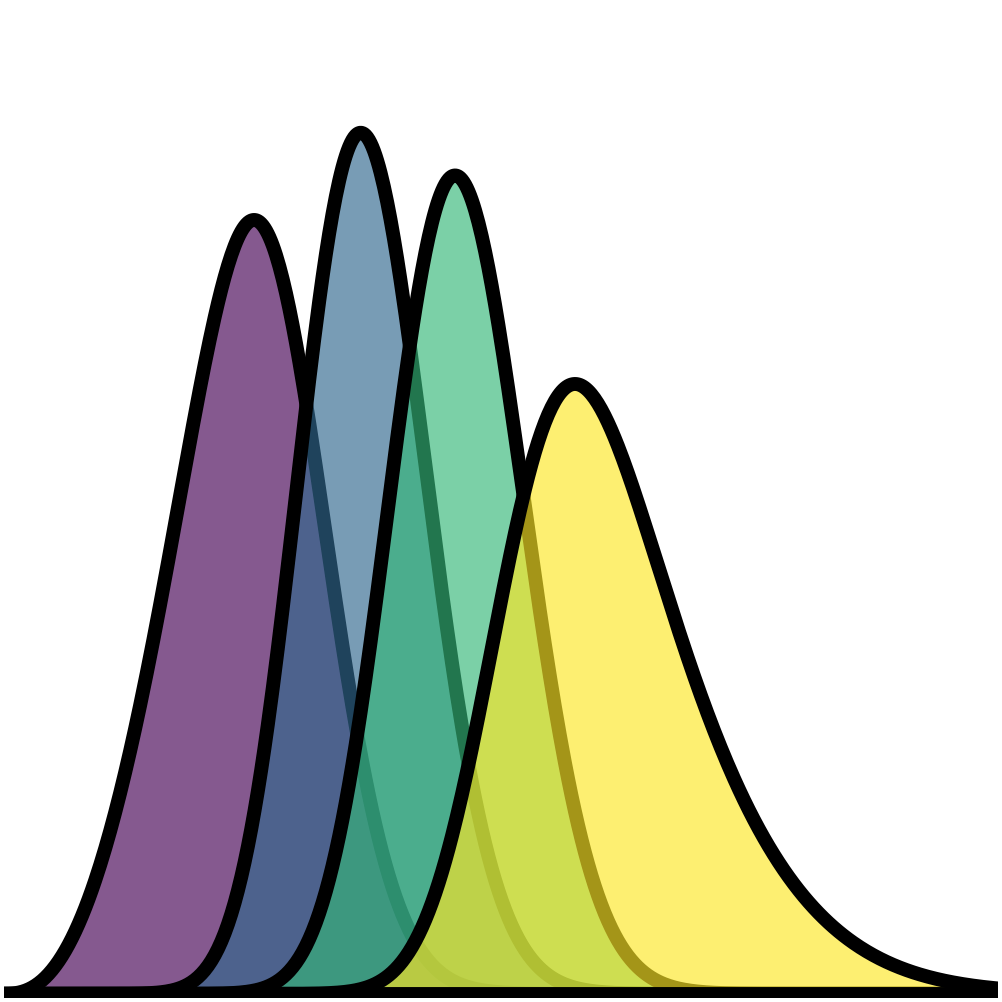
 Architecture#
Binny is a modular Python framework for modeling, constructing, calibrating, and analyzing galaxy redshift distributions and tomographic samples in cosmology.
Its architecture separates galaxy population modeling, binning, tomographic construction, observational calibration, statistical analysis, and survey-specific configurations into distinct components.
These components can be used independently or combined through a unified functional API, allowing users to construct workflows appropriate to their scientific applications without imposing a particular survey, observational model, or analysis strategy.
This page introduces the main components of Binny, explains their responsibilities, and describes how they work together.
The six pillars of Binny#
Binny is organized around six primary public API namespaces.
Each namespace addresses a distinct scientific or computational task, from defining a galaxy population to constructing and analyzing tomographic redshift distributions.
Namespace |
Responsibility |
Functionality |
|---|---|---|
|
Galaxy population modeling |
Defines, loads, and samples parent redshift distributions, including analytic, tabulated, and luminosity-function-based models. |
|
Binning and galaxy assignment |
Constructs and resolves bin boundaries, defines assignment and selection prescriptions, and computes binned redshift distributions. |
|
Tomographic construction and representation |
Combines galaxy populations, binning prescriptions, and assignment models into a unified tomographic representation. Also supports externally supplied tomographic distributions. |
|
Observational calibration and fitting |
Fits photometric redshift-error models and calibrates galaxy redshift distributions, number densities, survey depth, and observational selection effects from mock catalogs. |
|
Statistical analysis and sample manipulation |
Computes distribution statistics, population properties, overlap, leakage, correlations, bin combinations, and comparisons, and supports sample composition. |
|
Survey configurations and presets |
Provides survey-specific assumptions, configuration-driven tomography construction, and survey area and number-density conversions. |
The six namespaces provide distinct but complementary functionality.
A workflow does not need to use all six components. For example, users may construct a parent redshift distribution without performing tomography, calibrate an observational model without constructing bins, or analyze externally supplied tomographic distributions without using a Binny binning prescription.
Galaxy population modeling: binny.nz#
The binny.nz namespace provides tools for defining and
working with galaxy redshift distributions.
A parent redshift distribution, \(n(z)\), describes the underlying galaxy population before tomographic selection.
Supported functionality includes:
Analytic redshift distribution models.
Tabulated and externally supplied redshift distributions.
Luminosity-function-based redshift distributions.
Registration and retrieval of distribution models.
Sampling individual galaxy redshifts from a distribution.
Construction of mock redshift catalogs, optionally including observational redshifts and galaxy weights.
The parent distribution is independent of the binning and tomography construction procedures.
The same galaxy population can therefore be reused across different binning schemes, observational assumptions, and survey configurations.
Conversely, different galaxy population models can be compared while keeping the remaining components of the analysis fixed.
Binning and galaxy assignment: binny.binning#
The binny.binning namespace defines how galaxy populations
are divided into bins.
Binning involves two conceptually distinct operations:
Determining where the bin boundaries lie.
Determining how galaxies are assigned to those bins.
The first operation defines the binning geometry. The second defines the selection or assignment prescription.
Supported binning schemes include equidistant, equipopulated, equal-information, logarithmic, geometric, power-law, Chebyshev, sinh, and generalized binning.
Users can also supply explicit bin boundaries, register custom binning schemes, restrict the binning range, or combine multiple schemes into segmented binning configurations.
Galaxy assignment can incorporate:
Deterministic redshift selection.
Spectroscopic redshift uncertainties.
Photometric redshift uncertainties.
Systematic redshift offsets.
Catastrophic outlier populations.
Response matrices.
User-defined assignment functions.
Separating bin boundaries from galaxy assignment allows users to investigate observational uncertainties without modifying the underlying binning geometry.
Similarly, alternative binning strategies can be evaluated while keeping the observational model fixed.
The binning functionality can be used directly or through the higher-level tomography construction interface.
Tomographic construction: binny.tomography#
The binny.tomography namespace provides the construction
and representation of tomographic redshift distributions.
Given a parent redshift distribution \(n(z)\) and a selection probability \(S_i(z)\), the unnormalized tomographic redshift distribution for bin \(i\) is
The selection function describes the probability that a galaxy at true redshift \(z\) is assigned to tomographic bin \(i\).
For an observational redshift \(z_{\mathrm{obs}}\) with conditional probability density \(p(z_{\mathrm{obs}} \mid z)\), selection into a bin with boundaries \(a_i\) and \(b_i\) can be expressed as
This formulation separates the underlying galaxy population from the observational prescription used to assign galaxies to tomographic bins.
The resulting bin distributions may optionally be normalized according to the requirements of the analysis.
The main construction interfaces are:
build_tomographyfor direct functional construction.build_tomography_from_specfor construction from a structured tomography specification.build_predefined_tomographyfor constructing tomography from externally supplied bin distributions.load_predefined_binsfor loading externally supplied tomographic distributions.
These construction pathways use a common Tomography
representation containing the redshift grid, parent
distribution, tomographic bin distributions, and associated
information where available.
Externally supplied tomographic distributions do not need to be reconstructed using a Binny binning or assignment prescription.
The responsibility of this namespace is to construct and represent tomography.
Statistical analysis, distribution comparisons, and sample
composition are provided separately by binny.analysis.
Observational calibration: binny.calibration#
The binny.calibration namespace connects observational
or simulated galaxy samples to the models used in redshift
distribution and tomography construction.
Rather than requiring all model parameters to be specified manually, calibration allows relevant quantities to be estimated from galaxy catalogs.
Supported functionality includes:
Fitting Smail-type redshift distribution parameters.
Calibrating magnitude-dependent galaxy redshift distributions.
Calibrating galaxy number densities as a function of survey depth or limiting magnitude.
Fitting photometric redshift-error distributions, including core and outlier populations.
Converting fitted photometric redshift-error parameters into Binny-compatible model parameters.
Modeling PSF-dependent galaxy selection.
Constructing weighted redshift distributions from mock galaxy catalogs.
Estimating selected galaxy number densities.
Calibration and model evaluation are distinct operations.
For example, a redshift distribution model can be evaluated
directly through binny.nz, while its parameters can be
estimated from a mock catalog through binny.calibration.
Similarly, a photometric redshift assignment model can be
evaluated through binny.binning, while its uncertainty
parameters can be estimated through binny.calibration.
Calibrated distributions and model parameters can subsequently be used as inputs to tomography construction.
Calibration is optional. Users with externally determined model parameters or redshift distributions can use those inputs directly.
Statistical analysis: binny.analysis#
The binny.analysis namespace provides tools for examining,
comparing, and manipulating redshift distributions and
tomographic samples.
These operations are independent of how the distributions were originally constructed.
The analysis tools can therefore be applied to Binny-generated tomography, observational data products, simulations, or externally supplied tomographic distributions.
Capability |
Functionality |
|---|---|
Distribution statistics |
Compute means, medians, modes, moments, quantiles, distribution widths, bin centers, and peak diagnostics. |
Population statistics |
Compute galaxy fractions, number densities, galaxy counts, comoving number densities, and in-range population fractions. |
Distribution comparisons |
Quantify similarities and differences between redshift distributions and tomographic samples. |
Overlap and leakage |
Examine the relationships between tomographic bins and quantify population leakage between redshift intervals. |
Correlations |
Evaluate statistical relationships between distributions using correlation and overlap metrics. |
Bin combinations |
Construct and filter bin pairs and higher-order bin combinations using distribution properties, overlap, and other selection criteria. |
Sample composition |
Combine parent distributions and tomographic samples, align different redshift grids, interpolate distributions, and construct sample combinations. |
These capabilities support both exploratory analyses and the preparation of tomographic inputs for downstream cosmological calculations.
Analysis is not restricted to the final stage of a workflow.
For example, overlap and population statistics can be used to assess alternative binning schemes, compare observational models, or evaluate the consequences of different calibration prescriptions.
Survey configurations: binny.surveys#
The binny.surveys namespace provides configuration-driven
workflows and survey-specific assumptions.
Survey configurations can describe:
Parent redshift distribution models.
Lens and source galaxy populations.
Survey years, scenarios, and sample definitions.
Tomographic binning prescriptions.
Photometric and spectroscopic redshift uncertainties.
Galaxy number densities.
Survey areas.
Sample-dependent properties.
The build_survey_tomography interface uses these
configurations to construct tomographic samples through
the underlying Binny framework.
The namespace also provides utilities for inspecting survey configurations and converting between survey area, sky fraction, solid angle, and angular number-density units.
Survey presets do not constitute a separate numerical implementation of tomography.
Instead, they provide a structured way to define inputs to the same galaxy population, binning, and tomography construction machinery available through the functional API.
Users may therefore choose between predefined survey configurations, custom configurations, structured tomography specifications, and direct Python construction.
Supporting namespaces#
In addition to the six primary API namespaces, Binny provides specialized and shared functionality through supporting namespaces.
These modules remain independently accessible and can be used directly when their functionality is needed outside the primary workflow.
Namespace |
Responsibility |
Functionality |
|---|---|---|
|
Coordinate grids and bin boundaries |
Provides coordinate grid generators and numerical implementations of bin-edge construction schemes. |
|
Correlation and combination utilities |
Provides distribution metrics, scoring functions, bin-combination filtering, and pair and tuple construction utilities. |
|
Cosmological calculations |
Provides cosmology-dependent distances, volume weights, and redshift-related quantities used by supported distribution and binning models. |
|
Shared utilities |
Provides numerical integration and normalization, validation, interpolation-related utilities, metadata, file loading, and visualization utilities. |
Selected functionality from the supporting namespaces is also exposed through the primary API namespaces where appropriate.
For example, bin-edge generators are accessible through
binny.binning, while correlation and bin-combination
utilities are accessible through binny.analysis.
These interfaces reuse the underlying implementations rather than introducing separate numerical prescriptions.
How the components work together#
The components of Binny are designed to support flexible scientific workflows rather than enforce a single sequence of operations.
A typical tomography construction workflow can be represented as follows:
              Galaxy catalogs
                    |
                    v
            binny.calibration
                    |
           Calibrated parameters
                    |
                    v
binny.nz                         binny.binning
Parent n(z)                 Boundaries and selection
     |                                  |
     +----------------+-----------------+
                      |
                      v
              binny.tomography
              Tomographic samples
                      |
                      v
                binny.analysis
        Statistics and sample manipulation
The diagram represents conceptual relationships between the components rather than a strict sequence of function calls.
Calibration is optional, and parent distributions and assignment parameters can be supplied directly.
The tomography construction interfaces coordinate the necessary binning operations internally, while the individual components remain independently accessible.
Survey configurations provide an additional entry point to this workflow:
      binny.surveys
    Survey configuration
             |
             v
Population and binning inputs
             |
             v
     binny.tomography
     Tomographic samples
             |
             v
       binny.analysis
Alternatively, externally supplied tomographic distributions can bypass parent distribution modeling and galaxy assignment:
External tomographic distributions
              |
              v
      binny.tomography
              |
              v
        binny.analysis
These workflows produce a common tomographic representation, allowing the same analysis tools to be applied regardless of the origin of the distributions.
Choosing a workflow#
The appropriate entry point depends on the available inputs and the scientific objective.
Scientific task |
Recommended namespace |
|---|---|
Construct an analytic or tabulated parent redshift distribution. |
|
Generate a mock galaxy redshift catalog. |
|
Compare alternative binning schemes. |
|
Model photometric or spectroscopic redshift uncertainties. |
|
Estimate photometric redshift-error parameters from a galaxy catalog. |
|
Calibrate redshift distributions and galaxy number densities as a function of survey depth. |
|
Construct tomography from a parent population and an assignment model. |
|
Load externally supplied tomographic distributions. |
|
Evaluate tomographic populations, overlap, leakage, and distribution statistics. |
|
Combine or compare multiple tomographic samples. |
|
Select bin pairs or higher-order bin combinations for a cosmological analysis. |
|
Construct tomography using survey-specific assumptions. |
|
Design principles#
The organization of Binny is based on several principles.
Separation of responsibilities
Galaxy population modeling, binning, tomography construction, calibration, and statistical analysis are distinct operations with different scientific responsibilities.
Independent components
Individual components can be used outside a complete tomographic workflow, allowing users to adopt only the functionality required by their analysis.
Functional construction
The primary construction interfaces accept explicit inputs and return results without requiring stateful builder objects or a prescribed sequence of configuration steps.
Reusable numerical implementations
Direct construction, structured specifications, and survey presets share the underlying numerical machinery.
Observational flexibility
Different galaxy populations, redshift-error models, selection functions, and survey assumptions can be combined without requiring changes to the overall tomography framework.
Support for external data
Externally supplied redshift distributions and tomographic samples can be incorporated without requiring them to be reconstructed through Binny.
Interoperability
Redshift distributions, tomographic samples, calibrated model parameters, and statistical diagnostics can be used as inputs to external cosmological modeling, simulation, forecasting, and inference frameworks.
Further reading#
See Examples for worked examples illustrating the different components and construction workflows.
See binny package for the complete API reference, including the primary and supporting namespaces.