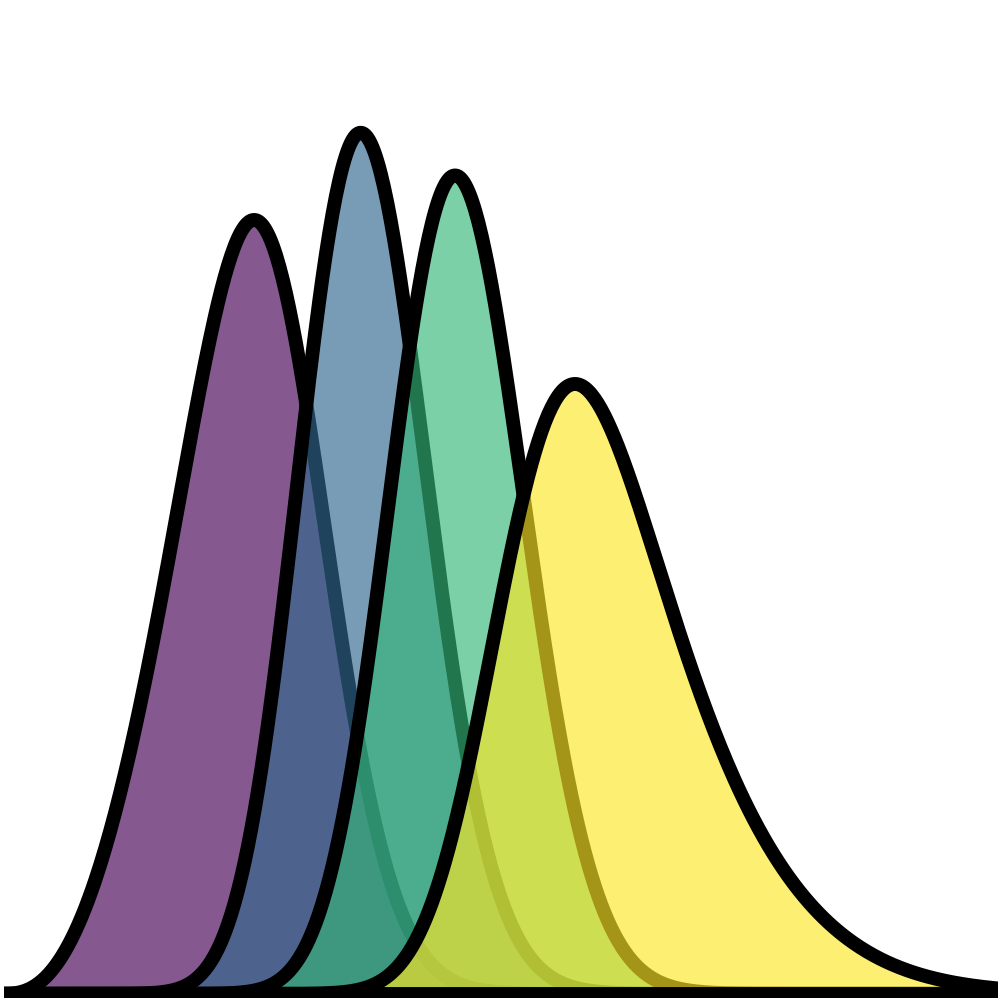
 Parent redshift distributions#
This section describes how Binny models the underlying analytic parent redshift distribution \(n(z)\) used throughout tomographic analyses.
A parent \(n(z)\) describes the redshift structure of a galaxy population before any tomographic binning is applied. Binny provides both analytic parent distribution models and workflows for calibrating survey-motivated distributions from mock catalogs.
For examples showing how to evaluate parent distributions in practice, see the corresponding examples pages.
Overview#
A tomographic analysis begins with a parent redshift distribution
which describes how galaxies are distributed in redshift before any tomographic selection is applied.
In Binny, the parent distribution serves as the starting point for constructing tomographic bins, overlap diagnostics, photo-z modelling, and downstream forecasting calculations.
Binny currently supports two complementary approaches:
direct analytic parent-distribution models;
calibration of survey-motivated parent distributions from mock catalogs.
In addition, Binny provides luminosity-function-weighted redshift distributions that connect the parent \(n(z)\) directly to a galaxy luminosity function, survey magnitude limits, and cosmology-dependent volume effects.
Parent distribution modelling#
The pages below describe the parent-distribution modelling approaches implemented in Binny.