 Redshift uncertainties#
This section describes how Binny models uncertainty in tomographic redshift binning.
For a broader introduction to tomography and redshift-selection models, see Tomography.
Binny supports two broad classes of redshift uncertainty treatment:
Photometric-redshift uncertainties for photometric-redshift uncertainties, where bins are defined in observed redshift and mapped onto the true-redshift grid through a probabilistic assignment model;
Spectroscopic-redshift uncertainties for spectroscopic-redshift uncertainties, where bins are defined in true redshift and may be modified by completeness losses, bin-to-bin response effects, catastrophic reassignment, or measurement scatter.
In both cases, the returned tomographic bins are evaluated on a common true-redshift grid \(z\).
Overview#
Binny constructs tomographic bins by applying an effective redshift-selection model to a parent redshift distribution \(n(z)\). Schematically,
where
\(n(z)\) is the parent redshift distribution,
\(n_i(z)\) is the returned tomographic bin for bin \(i\),
\(S_i(z)\) is the effective selection function.
The interpretation of \(S_i(z)\) depends on the redshift model:
in the photo-z case, \(S_i(z) = P(i \mid z)\), the probability of assigning an object at true redshift \(z\) to observed bin \(i\);
in the spec-z case, \(S_i(z)\) is a true-redshift selection, possibly followed by an observed-bin response model.
Conceptually, the distinction is:
photo-z tomography is probabilistic from the outset;
spec-z tomography starts from deterministic true-redshift bins and then optionally adds observational response effects.
Uncertainty models#
The pages below describe the uncertainty models implemented in Binny.
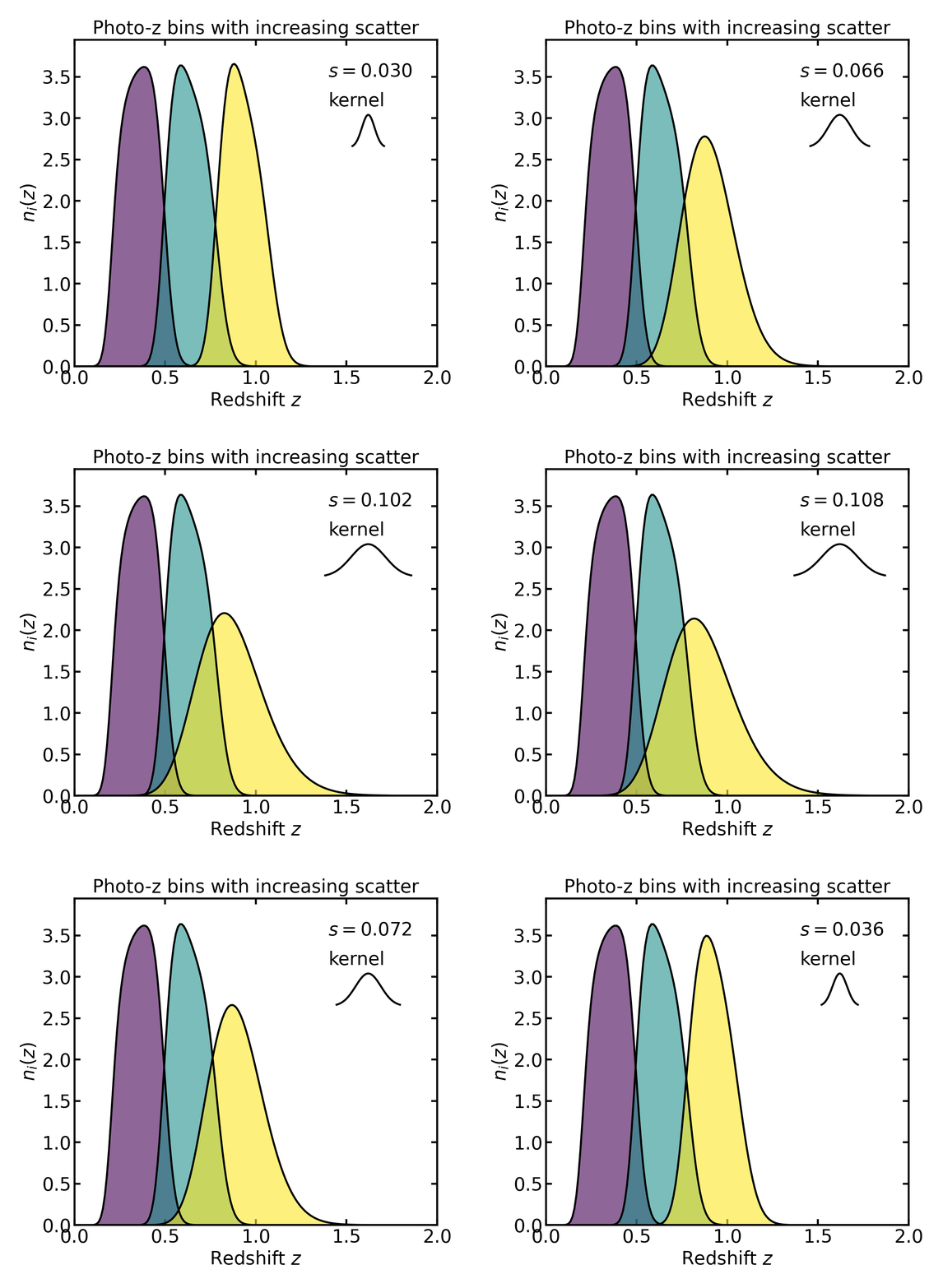
Photometric redshift tomography assigns galaxies to bins probabilistically. These models capture scatter, bias, and catastrophic outliers in the mapping between observed and true redshift.
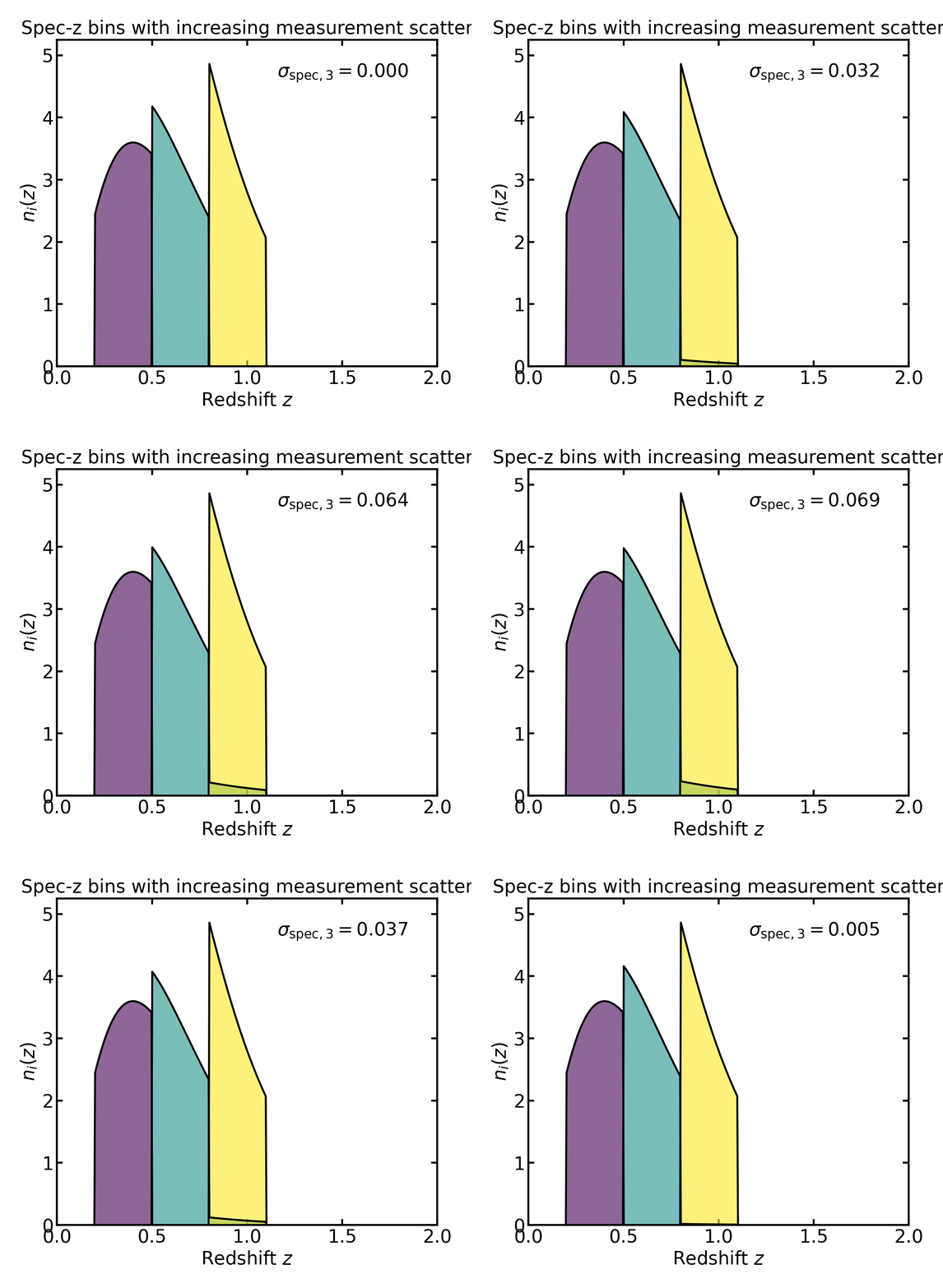
Spectroscopic tomography begins with deterministic true-redshift bins and may include additional observational effects such as incompleteness, bin reassignment, or measurement scatter.