 Sample composition#
Binny can combine several tomographic samples into one logical sample collection. This is useful when different galaxy samples should contribute to one parent redshift distribution, while still preserving sample-aware bin labels for downstream selections and data-vector construction.
There are two common use cases:
physically adding samples together, for example when LRG and ELG should be treated as one effective lens population;
keeping samples separate but using sample-aware labels, for example when a data vector must distinguish
("LRG", 0)from("ELG", 0).
The first case uses combine_parent_nz or combine_tomography_bins. The
second case uses sample_bin_labels, sample_bins, and
sample_combinations.
This example uses the DESI survey preset and combines the DESI LRG and ELG lens samples.
Combining DESI parent samples#
Parent-sample composition adds the parent redshift distributions. If samples are
defined on different redshift grids, interpolate=True maps them onto a common
grid before summing. By default, the first sample grid is used as the target
grid unless z_target is provided explicitly.
from binny import NZTomography


lrg_tomo = NZTomography()
elg_tomo = NZTomography()

lrg = lrg_tomo.build_survey_bins(
    "desi",
    role="lens",
    sample="lrg",
    overrides={"bins": {"edges": [0.4, 0.6, 0.8, 1.0]}},
)

elg = elg_tomo.build_survey_bins(
    "desi",
    role="lens",
    sample="elg",
    overrides={"bins": {"edges": [0.6, 0.9, 1.2, 1.5]}},
)

z_combined, nz_combined = NZTomography.combine_parent_nz(
    [
        {"z": lrg.z, "nz": lrg.nz},
        {"z": elg.z, "nz": elg.nz},
    ],
    interpolate=True,
)
The returned arrays are plain NumPy arrays. This makes the combined parent distribution easy to inspect, plot, or pass into another custom binning step.
Visualizing parent sample composition#
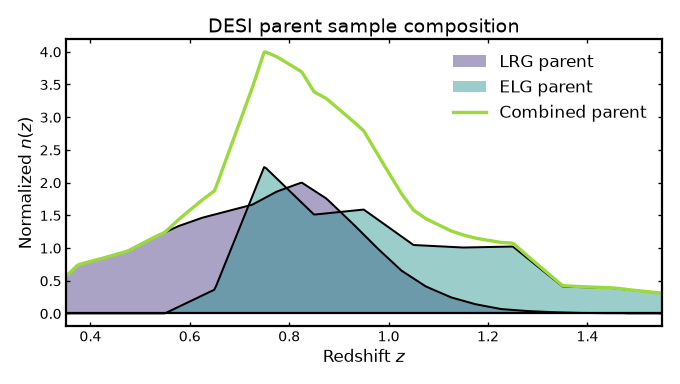
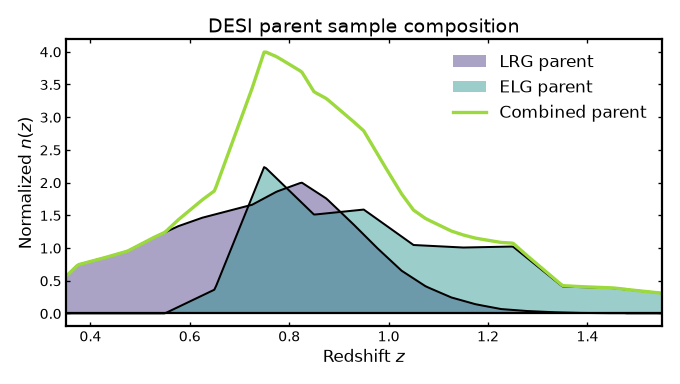
The figure below compares the DESI LRG and ELG parent redshift distributions with their combined parent distribution.
(Source code, png, hires.png, pdf)
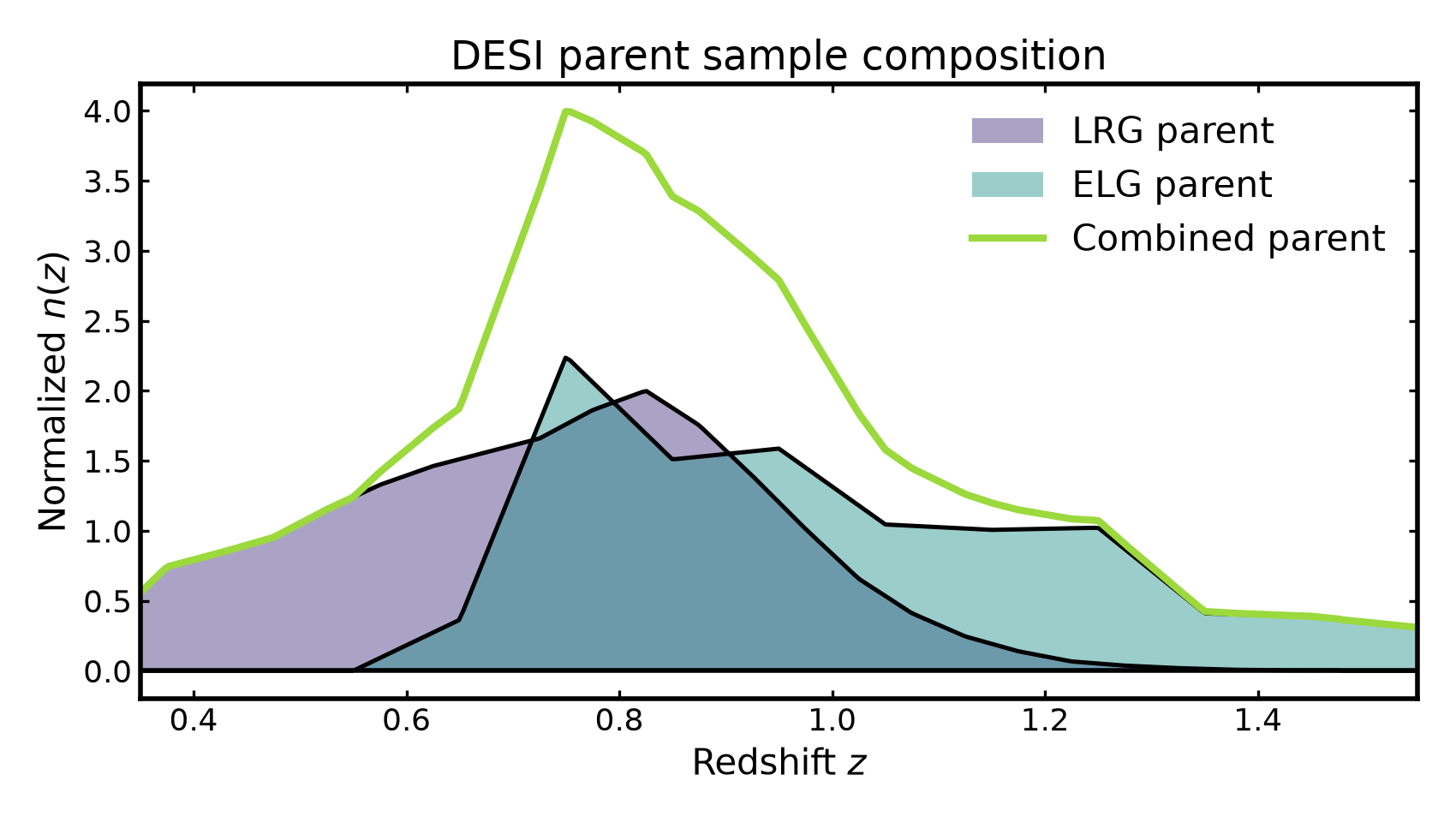
Parent-level composition is useful for visual checks, but many analyses need the
tomographic bins themselves. In that case, matching bin indices can be summed
directly. This requires the samples to have the same bin keys. For example, bin
0 in the combined sample is the sum of bin 0 from each input sample.
Combining matching tomographic bins#
If different samples use the same number of tomographic bins, their matching bin indices can also be added together.
combined = NZTomography.combine_tomography_bins(
    [lrg, elg],
    interpolate=True,
)
Visualizing combined tomography#
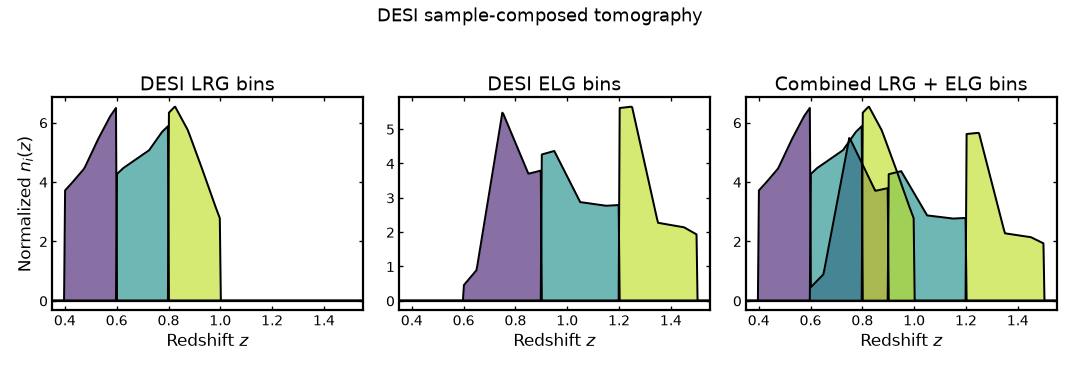
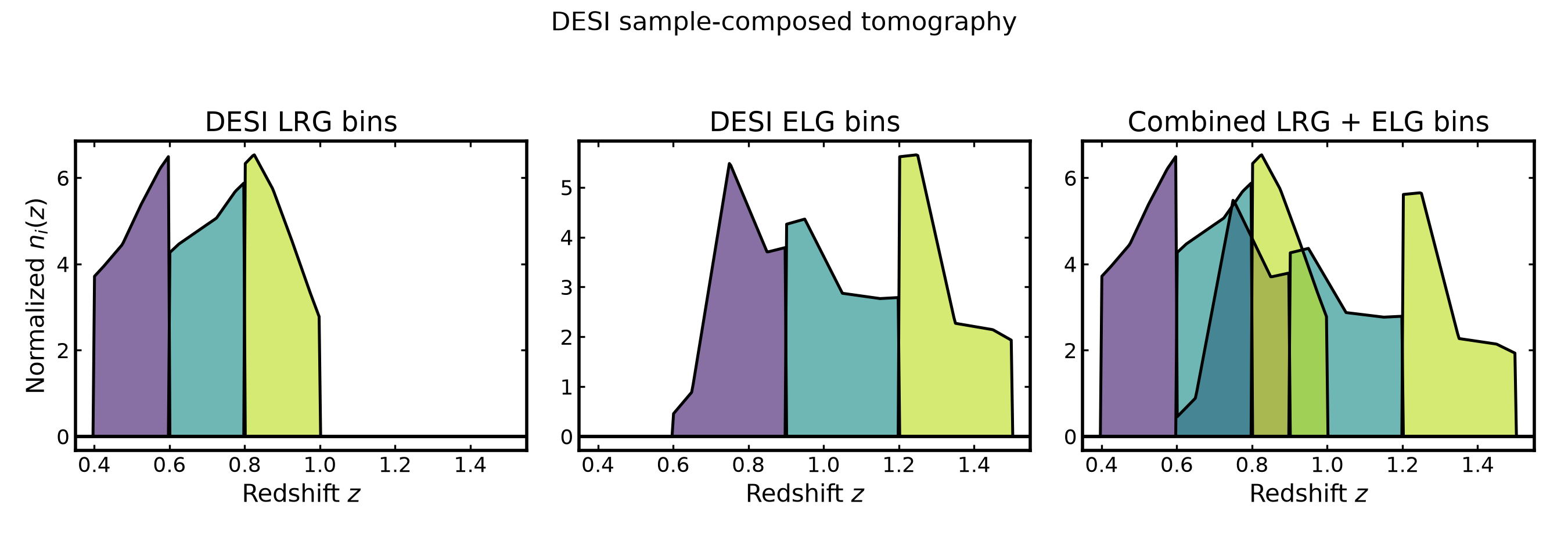
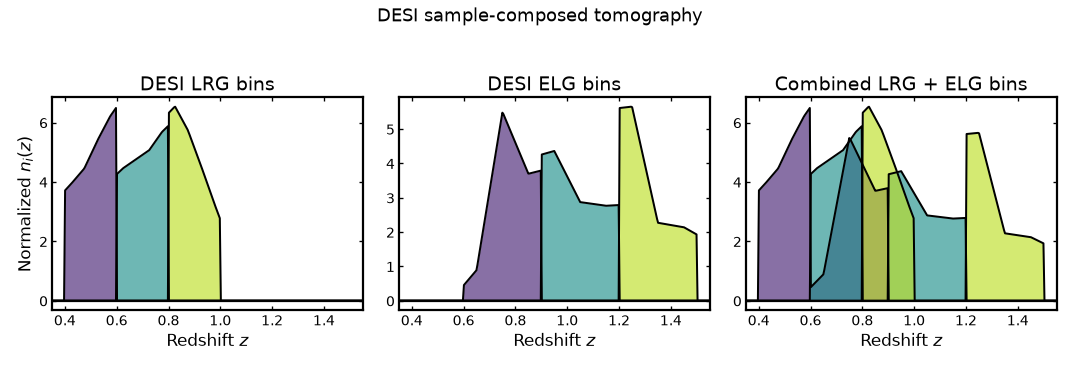
The figure below shows the DESI LRG bins, DESI ELG bins, and the combined tomographic sample obtained by summing matching bin indices.
(Source code, png, hires.png, pdf)
Preserving sample-aware bin labels#
Sometimes samples should not be summed. Instead, each sample and bin should remain identifiable. This is useful for building sample-aware data vectors.
lenses = {
    "LRG": lrg,
    "ELG": elg,
}

labels = NZTomography.sample_bin_labels(lenses)
bins = NZTomography.sample_bins(lenses)

print(labels)
Building sample-aware combinations#
Sample-aware combinations preserve both the sample name and the bin index.
sources = {
    "LSST": lsst_source,
}

lens_source_pairs = NZTomography.sample_combinations(
    lenses,
    sources,
)

print(lens_source_pairs)
For example, if lenses contains DESI LRG and ELG bins, and sources
contains LSST source bins, the resulting labels have the form
(("LRG", 0), ("LSST", 0))
(("LRG", 1), ("LSST", 0))
(("ELG", 0), ("LSST", 0))
These labels preserve both the sample identity and tomographic bin index. They can be passed directly to pair-selection routines, covariance builders, forecasting pipelines, or other downstream analyses without losing track of which physical sample each bin originated from.
Summary#
Binny supports two complementary approaches for working with multiple tomographic samples:
combine_parent_nzcombines parent redshift distributions;combine_tomography_binscombines matching tomographic bins;sample_bin_labelsandsample_binsflatten multiple samples while preserving sample identities;sample_combinationsconstructs sample-aware combinations across one or more collections.
Together, these utilities make it possible to either merge samples into a single effective population or preserve their identities for analyses that require sample-aware bookkeeping.