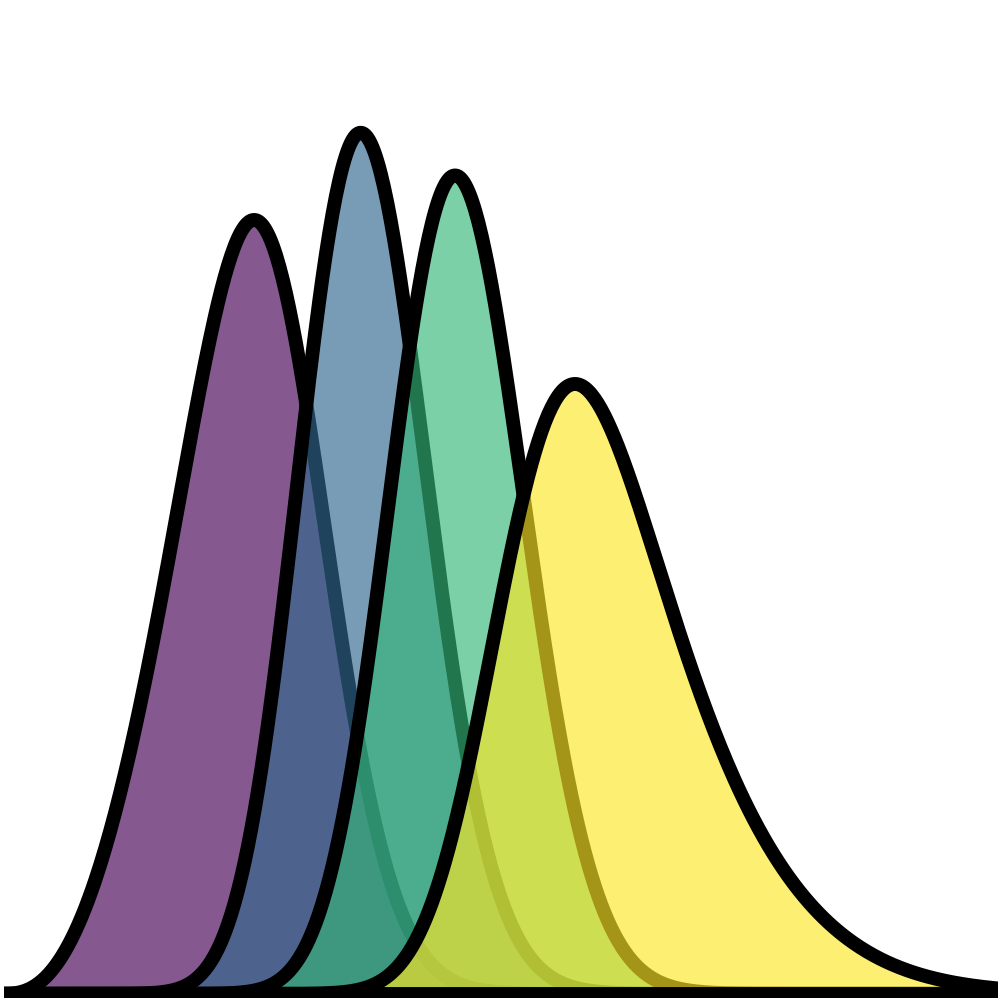
 PSF-dependent source selection#
Binny also implements a workflow for studying how image quality changes the source populations used in weak lensing analyses.
In realistic surveys, galaxy detection is not the only selection effect. Even after a galaxy is detected, it may not be sufficiently resolved relative to the point-spread function (PSF) to provide a reliable shape measurement.
This means that changes in the PSF can modify both the selected source density and the redshift distribution of galaxies available for cosmological analyses.
The calibration tools implemented in Binny perform three related tasks:
estimate PSF-dependent source selection weights,
calibrate how the selected source density changes with PSF size,
construct source redshift distributions after depth and PSF selection.
This is exposed through
binny.NZTomography.calibrate_psf_depth_from_mock().
The idea is straightforward. Given a mock catalog containing true redshifts, apparent magnitudes, and galaxy sizes, one considers a sequence of survey depths and PSF values. For each combination, galaxies are first selected by magnitude and then weighted according to how well they are resolved relative to the PSF.
The output is therefore not only a set of redshift distributions, but also a calibration describing how the selected source population changes as image quality varies.
Selection model#
The calibration combines two forms of source selection.
First, galaxies are selected according to a limiting magnitude,
where \(m\) is the apparent magnitude of a galaxy and \(m_{\rm lim}\) is the limiting magnitude of the survey.
Second, the contribution of each selected galaxy is weighted according to how well it is resolved relative to the PSF.
Binny describes this through a resolution factor,
where \(r_{\rm gal}\) is a characteristic galaxy size and \(r_{\rm PSF}\) is the characteristic PSF size in the same units. A galaxy is resolved if its resolution factor is around 1, and is unresolved if its resolution factor is around 0.
The resolution factor is converted into a source-selection weight \(w(R)\), either through a hard threshold or through a smooth transition around a minimum resolution threshold.
These weights are then used when estimating source redshift distributions and selection-weighted source densities from the mock catalog.
As the PSF increases, the resolution factor generally decreases, reducing the contribution of small galaxies to the source population. Because small galaxies are often preferentially found at higher redshift, this process can modify both the selected source density and the shape of the resulting redshift distribution.
In this way, the calibration approximates the loss of poorly resolved galaxies as image quality changes, allowing PSF-dependent source populations to be propagated into forecasting calculations.
Why PSF calibration matters#
Weak lensing forecasts depend on the galaxies that can be used for shape measurements rather than simply the galaxies that can be detected.
As the PSF becomes larger, small galaxies become increasingly difficult to resolve. In the phenomenological selection model used here, this usually changes the source sample in two ways:
the selected source density decreases,
the redshift distribution can shift as poorly resolved galaxies are downweighted or removed.
Because high-redshift galaxies often have smaller apparent sizes, PSF selection can alter the shape of the parent \(n(z)\) as well as the overall source density.
In the Binny calibration workflow, these effects are summarized by constructing PSF-dependent source populations directly from mock catalogs.
This provides a compact description of how image quality propagates into forecasting inputs without requiring the full mock catalog to be carried through every later calculation.
What the calibration does not do#
The calibration tools are designed to provide a phenomenological summary of how source populations change with image quality. They are not intended to reproduce every aspect of a shear measurement pipeline.
In particular, the calibration should not be interpreted as a complete model of shape measurement, PSF correction, or shear estimation.
Rather, it provides a compact approximation to the dominant selection effects that arise because poorly resolved galaxies are downweighted or removed from the selected weak lensing source population.
Similarly, the resulting selected source density and redshift distribution relations are empirical summaries of the mock catalog. They are useful for forecasting and survey studies, but they do not replace the full information content of image simulations or end-to-end analyses.
The selected source density should not be confused with the conventional noise-equivalent weak-lensing effective number density \(n_{\rm eff}\). The Binny calibration describes changes in the selected source population; it does not model the additional measurement-noise weighting required to construct \(n_{\rm eff}\).
This distinction is important for the theory documentation: Binny implements a practical interface for modelling changes in source populations, not a complete weak lensing measurement framework.
Connection to tomography#
Once a source population has been calibrated, Binny uses the resulting redshift distributions as inputs for tomographic analyses.
The PSF calibration itself does not define tomographic bins. Instead, it determines the parent population available for subsequent tomographic selection.
It is therefore useful to keep the conceptual separation clear:
the PSF calibration determines the selected source population,
the tomography step determines how those galaxies are partitioned into bins.
Changes in image quality can therefore affect tomography indirectly by modifying the parent source population from which the tomographic bins are constructed.
Summary#
Binny implements calibration tools for PSF-dependent source selection because image quality can alter both the selected source density and the redshift distribution used in weak lensing forecasts.
Using mock catalogs containing galaxy redshifts, magnitudes, and sizes, the calibration constructs source populations across a range of survey depths and PSF conditions.
This allows image quality effects to be propagated into tomographic forecasting calculations without requiring the full mock catalog to be reprocessed for every scenario.
For executable usage examples, see the example pages on PSF-dependent source selection and calibration from mocks.